Nib and Ink the Art of Creative Handwriting and Modern Calligraphy
Calligraphy (from Greek: καλλιγραφία) is a visual art related to writing. It is the design and execution of lettering with a pen, ink brush, or other writing instrument.[1] : 17 A contemporary calligraphic practice can exist divers equally "the art of giving grade to signs in an expressive, harmonious, and expert style".[1] : xviii
Modern calligraphy ranges from functional inscriptions and designs to fine-art pieces where the letters may or may not be readable.[1] [ page needed ] Classical calligraphy differs from blazon blueprint and non-classical hand-lettering, though a calligrapher may practice both.[2] [three] [4] [5]
Calligraphy continues to flourish in the forms of hymeneals invitations and event invitations, font design and typography, original hand-lettered logo pattern, religious art, announcements, graphic design and deputed calligraphic art, cut rock inscriptions, and memorial documents. It is too used for props and moving images for pic and idiot box, and also for testimonials, birth and expiry certificates, maps, and other written works.[half dozen] [7]
Tools [edit]
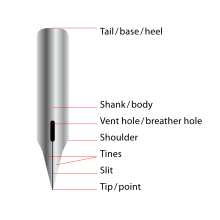
A calligraphic bill, with part names
The principal tools for a calligrapher are the pen and the brush. Calligraphy pens write with nibs that may be flat, round, or pointed.[8] [nine] [10] For some decorative purposes, multi-nibbed pens—steel brushes—can be used. However, works have besides been created with felt-tip and ballpoint pens, although these works exercise not employ angled lines. There are some styles of calligraphy, such as Gothic script, that crave a stub pecker pen.
Writing ink is usually h2o-based and is much less viscid than the oil-based inks used in press. Certain specialty paper with high ink assimilation and constant texture enables cleaner lines,[11] although parchment or vellum is oft used, as a knife can be used to erase imperfections and a low-cal-box is not needed to let lines to pass through it. Normally, low-cal boxes and templates are used to accomplish straight lines without pencil markings detracting from the work. Ruled paper, either for a calorie-free box or direct utilise, is most oft ruled every quarter or half inch, although inch spaces are occasionally used. This is the case with litterea unciales (hence the name), and college-ruled paper oft acts as a guideline well.[12]
Common calligraphy pens and brushes are:
- Quill
- Dip pen
- Ink brush
- Qalam
- Fountain pen
- Chiselled marker
World traditions [edit]
East Asia and Vietnam [edit]
Chinese calligraphy is locally called shūfǎ or fǎshū ( 書法 or 法書 in Traditional Chinese, literally "the method or constabulary of writing");[13] Japanese calligraphy is shodō ( 書道 , literally "the way or principle of writing");[14] Korean calligraphy is called seoye (Korean: 서예/ 書藝 , literally "the art of writing");[15] and Vietnamese calligraphy is chosen thư pháp (Vietnamese: Thư pháp/書法, literally "the way of letters or words"). The calligraphy of East Asian characters is an important and appreciated aspect of traditional Due east Asian culture.
History [edit]

Chinese soldier in calligraphy competition
In ancient China, the oldest known Chinese characters are oracle bone script (甲骨文), carved on ox scapulae and tortoise plastrons, considering the rulers in the Shang Dynasty carved pits on such animals' basic and then baked them to proceeds augury of armed services affairs, agricultural harvest, or even procreating and weather.[ clarification needed ] During the divination ceremony, after the cracks were fabricated, the characters were written with a brush on the beat or bone to be subsequently carved. (Keightley, 1978). With the development of Jīnwén (Bronzeware script) and Dàzhuàn (Large Seal Script)[sixteen] "cursive" signs continued. Mao Gong Ding is one of the nigh famous and typical Bronzeware scripts in Chinese calligraphic history. It has 500 characters on the statuary which is the largest number of statuary inscription we take discovered so far.[ clarification needed ] [17] Moreover, each archaic kingdom of electric current Red china had its own ready of characters.
In Imperial Red china, the graphs on old steles—some dating from 200 BCE, and in Xiaozhuan manner—are still accessible [ clarify ].
About 220 BCE, the emperor Qin Shi Huang, the first to conquer the entire Chinese basin, imposed several reforms, among them Li Si's character unification, which created a set of 3300 standardized Xiǎozhuàn (小篆) characters.[18] Despite the fact that the main writing implement of the time was already the brush, few papers survive from this menses, and the main examples of this style are on steles.
The Lìshū manner ( 隸書 / 隸书 ) (clerical script) which is more regularized, and in some ways like to modern text, were also authorised nether Qin Shi Huangdi.[19] [ self-published source? ]
Betwixt clerical script and traditional regular script, in that location is another transitional blazon of calligraphic work called Wei Bei. It started during the North and South dynasties (420 to 589 CE) and ended before the Tang Dynasty (618-907).[20]
Kǎishū mode (traditional regular script)—still in use today—and attributed to Wang Xizhi ( 王羲之 , 303–361) and his followers, is fifty-fifty more regularized.[19] Its spread was encouraged by Emperor Mingzong of Subsequently Tang (926–933), who ordered the printing of the classics using new wooden blocks in Kaishu. Printing technologies here allowed a shape stabilization. The Kaishu shape of characters yard years agone was mostly similar to that at the end of Imperial China.[19] Just small changes have been made, for example in the shape of 广 which is not admittedly the same in the Kangxi Dictionary of 1716 as in modern books. The Kangxi and electric current shapes have tiny differences, while stroke order is still the aforementioned, according to the old style.[21]
Styles which did not survive include Bāfēnshū, a mix of 80% Xiaozhuan style, and xx% Lishu fashion. [19] Some variant Chinese characters were unorthodox or locally used for centuries. They were by and large understood merely always rejected in official texts. Some of these unorthodox variants, in addition to some newly created characters, compose the Simplified Chinese grapheme set.
Technique [edit]
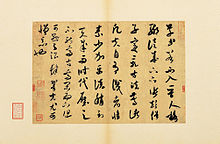
Traditional East Asian writing uses the Four Treasures of the Study ( 文房四寶 / 文房四宝 ):[22] ink brushes known every bit máobǐ ( 毛筆 / 毛笔 ) , Chinese ink, paper, and inkstones to write Chinese characters. These instruments of writing are also known as the 4 Friends of the Written report (Korean: 문방사우/文房四友, romanized: Munbang sau ) in Korea. Likewise the traditional four tools, desk pads and paperweights are also used.
Many unlike parameters influence the concluding result of a calligrapher's work. Physical parameters include the shape, size, stretch, and hair type of the ink brush; the color, color density and h2o density of the ink; as well equally the paper's water assimilation speed and surface texture. The calligrapher's technique besides influences the result, as the await of finished characters are influenced by the quantity of ink and water the calligraper lets the castor accept and by the pressure, inclination, and direction of the castor. Irresolute these variables produces thinner or bolder strokes, and smooth or toothed borders. Eventually, the speed, accelerations and decelerations of a skilled calligrapher'due south movements aim to give "spirit" to the characters, greatly influencing their final shapes.
Styles [edit]
Cursive styles such equally xíngshū ( 行書 / 行书 )(semi-cursive or running script) and cǎoshū ( 草書 / 草书 )(cursive, crude script, or grass script) are less constrained and faster, where more movements made by the writing implement are visible. These styles' stroke orders vary more than, sometimes creating radically different forms. They are descended from Clerical script, in the aforementioned time every bit Regular script (Han Dynasty), just xíngshū and cǎoshū were used for personal notes only, and never used every bit a standard. The cǎoshū style was highly appreciated in Emperor Wu of Han reign (140–187 CE).[nineteen]
Examples of modern printed styles are Song from the Song Dynasty's printing press, and sans-serif. These are not considered traditional styles, and are unremarkably not written.
Influences [edit]
Japanese, Korean and Vietnamese calligraphy were each profoundly influenced by Chinese calligraphy. Calligraphy has besides influenced ink and launder painting, which is achieved using similar tools and techniques. Calligraphy has influenced nigh major fine art styles in Eastward Asia, including ink and launder painting, a style of Chinese, Japanese, and Korean based entirely on calligraphy.
The Japanese, Korean and Vietnamese people have besides adult their own specific sensibilities and styles of calligraphy while incorporating Chinese influences.
Nihon [edit]

Japanese calligraphy goes out of the set of CJK strokes to as well include local alphabets such every bit hiragana and katakana, with specific problematics such equally new curves and moves, and specific materials (Japanese newspaper, washi 和紙 , and Japanese ink).[23]
Korea [edit]
The Hangeul and the existence of the circle required the cosmos of a new technique which usually confuses Chinese calligraphers.
-

Calligraphy by one of Korea's well-nigh historic calligraphists, Kim Jeong-hui (1786-1856).
-

Modernistic Korean calligraphy. Hangeuls meaning "Wiktionary".
Vietnam [edit]

Vietnamese calligraphy is quite special, since Vietnam has abolished the Chữ Nôm and Chữ Hán, an one-time Vietnamese writing system based on Chinese characters and replaced it with the Latin alphabet. All the same, the calligraphic traditions go along to be preserved.
Mongolia [edit]
Mongolian calligraphy is also influenced by Chinese calligraphy, from tools to fashion.
Tibet [edit]

Tibetan calligraphy is central to Tibetan civilization. The script is derived from Indic scripts. The nobles of Tibet, such as the High Lamas and inhabitants of the Potala Palace, were usually capable calligraphers. Tibet has been a center of Buddhism for several centuries, and that religion places a great bargain of significance on written word. This does non provide for a large body of secular pieces, although they do exist (but are ordinarily related in some way to Tibetan Buddhism). Almost all high religious writing involved calligraphy, including letters sent by the Dalai Lama and other religious and secular authority. Calligraphy is particularly axiomatic on their prayer wheels, although this calligraphy was forged rather than scribed, much similar Arab and Roman calligraphy is ofttimes found on buildings. Although originally washed with a reed, Tibetan calligraphers now use chisel tipped pens and markers also.
new motility [edit]
Temporary calligraphy is a practise of water-only calligraphy on the floor, which dries out within minutes. This practice is particularly appreciated by the new generation of retired Chinese in public parks of Prc. These will ofttimes open studio-shops in tourist towns offering traditional Chinese calligraphy to tourists. Other than writing the clients name, they also sell fine brushes as souvenirs and limestone carved stamps.
Since late 1980s, a few Chinese artists have branched out traditional Chinese calligraphy to a new territory by mingling Chinese characters with English messages; notable new forms of calligraphy are Xu Bing'south square calligraphy and DanNie's coolligraphy or cooligraphy.
Southeast Asia (except Vietnam) [edit]
Philippines [edit]

The Philippines has numerous ancient and ethnic scripts collectively chosen equally Suyat scripts. Various ethno-linguistic groups in the Philippines prior to Spanish colonization in the 16th century upwardly to the independence era in the 21st century accept used the scripts with various mediums. By the stop of colonialism, only four of the suyat scripts survived and go on to be used by certain communities in everyday life. These four scripts are Hanunó'o/Hanunoo of the Hanuno'o Mangyan people, Buhid/Buid of the Buhid Mangyan people, Tagbanwa script of the Tagbanwa people, and Palaw'an/Pala'wan of the Palaw'an people. All iv scripts were inscribed in the UNESCO Memory of the World Programme, under the name Philippine Paleographs (Hanunoo, Buid, Tagbanua and Pala'wan), in 1999.[24]

Due to dissent from colonialism, many artists and cultural experts have revived the usage of suyat scripts that went extinct due to Spanish persecution. These scripts being revived include the Kulitan script of the Kapampangan people, the badlit script of diverse Visayan indigenous groups, the Iniskaya script of the Eskaya people, the Baybayin script of the Tagalog people, and the Kur-itan script of the Ilocano people, among many others.[25] [26] [27] Due to the diversity of suyat scripts, all calligraphy written in suyat scripts are collectively chosen as Filipino suyat calligraphy, although each are distinct from each other.[28] [29] Calligraphy using the Western alphabet and the Arabic alphabet are also prevalent in the Philippines due to its colonial past, but the Western alphabet and the Arabic alphabet are not considered equally suyat, and therefore Western-alphabet and Arabic calligraphy are not considered every bit suyat calligraphy.[thirty] [31]
South asia [edit]
India [edit]

Religious texts are the nigh frequent purpose for Indian calligraphy. Monastic Buddhist communities had members trained in calligraphy and shared responsibility for duplicating sacred scriptures.[32] Jaina traders incorporated illustrated manuscripts celebrating Jaina saints. These manuscripts were produced using inexpensive textile, like palm get out and birch, with fine calligraphy.[33]
Nepal [edit]
Nepalese calligraphy is primarily created using the Ranjana script. The script itself, forth with its derivatives (like Lantsa, Phagpa, Kutila) are used in Nepal, Tibet, Kingdom of bhutan, Leh, Mongolia, coastal Japan, and Korea to write "Om mani padme hum" and other sacred Buddhist texts, mainly those derived from Sanskrit and Pali.
Africa [edit]
Egypt [edit]
Egyptian hieroglyphs were the formal writing system used in Ancient Egypt. Hieroglyphs combined logographic, syllabic and alphabetic elements, with a full of some ane,000 distinct characters.
Federal democratic republic of ethiopia/Abyssinia [edit]
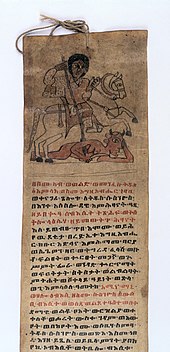
Ethiopian (Abyssinian) calligraphy began with the Ge'ez script, which replaced Epigraphic Southward Arabian in the Kingdom of Aksum, that was adult specifically for Ethiopian Semitic languages. In those languages that apply it, such every bit Amharic and Tigrinya, the script is called Fidäl , which means script or alphabet. The Epigraphic Due south Arabian letters were used for a few inscriptions into the eighth century, though not any South Arabian language since Dʿmt.
Early inscriptions in Ge'ez and Ge'ez script have been dated to as early as the 5th century BCE, and in a sort of proto-Ge'ez written in ESA since the 9th century BCE. Ge'ez literature begins with the Christianization of Ethiopia (and the civilization of Axum) in the 4th century, during the reign of Ezana of Axum.
The Ge'ez script is read from left to right and has been adapted to write other languages, commonly ones that are besides Semitic. The nearly widespread use is for Amharic in Ethiopia and Tigrinya in Eritrea and Ethiopia.
Europe [edit]
History [edit]
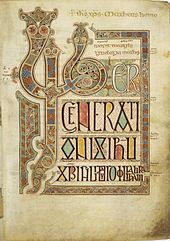
Western calligraphy is recognizable by the use of the Latin script. The Latin alphabet appeared most 600 BCE, in Rome, and by the kickoff century[ clarification needed ] developed into Roman imperial capitals carved on stones, Rustic capitals painted on walls, and Roman cursive for daily utilise. In the second and 3rd centuries the uncial lettering style developed. As writing withdrew to monasteries, uncial script was found more suitable for copying the Bible and other religious texts. It was the monasteries which preserved calligraphic traditions during the fourth and fifth centuries, when the Roman Empire fell and Europe entered the Dark Ages.[34]
At the elevation of the Empire, its power reached as far equally Great Uk; when the empire roughshod, its literary influence remained. The Semi-uncial generated the Irish gaelic Semi-uncial, the modest Anglo-Saxon.[35] Each region developed its own standards post-obit the principal monastery of the region (i.e. Merovingian script, Laon script, Luxeuil script, Visigothic script, Beneventan script), which are mostly cursive and hardly readable.

Christian churches promoted the development of writing through the prolific copying of the Bible, the Breviary, and other sacred texts.[36] Ii distinct styles of writing known as uncial and one-half-uncial (from the Latin "uncia", or "inch") developed from a variety of Roman bookhands.[37] The 7th–9th centuries in northern Europe were the heyday of Celtic illuminated manuscripts, such as the Book of Durrow, Lindisfarne Gospels and the Book of Kells.[38]
Charlemagne's devotion to improved scholarship resulted in the recruiting of "a crowd of scribes", according to Alcuin, the Abbot of York.[39] Alcuin developed the fashion known as the Caroline or Carolingian minuscule. The first manuscript in this hand was the Godescalc Evangelistary (finished 783)—a Gospel book written by the scribe Godescalc.[twoscore] Carolingian remains the one progenitor hand from which modernistic booktype descends.[41]
In the eleventh century, the Caroline evolved into the Gothic script, which was more meaty and made information technology possible to fit more text on a page.[42] : 72 The Gothic calligraphy styles became dominant throughout Europe; and in 1454, when Johannes Gutenberg developed the first press press in Mainz, Germany, he adopted the Gothic style, making it the first typeface.[42] : 141
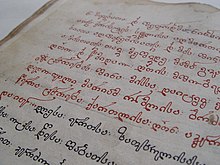
In the 15th century, the rediscovery of old Carolingian texts encouraged the creation of the humanist minuscule or littera antiqua. The 17th century saw the Batarde script from France, and the 18th century saw the English script spread across Europe and world through their books.
In the mid-1600s French officials, flooded with documents written in diverse hands and varied levels of skill, complained that many such documents were beyond their ability to decipher. The Office of the Financier thereupon restricted all legal documents to iii easily, namely the Coulee, the Rhonde, (known as Round hand in English language) and a Speed Paw sometimes simply chosen the Bastarda.[43]
While there were many great French masters at the time, the most influential in proposing these hands was Louis Barbedor, who published Les Ecritures Financière Et Italienne Bastarde Dans Leur Naturel circa 1650.[43]
With the destruction of the Camera Apostolica during the sack of Rome (1527), the capitol for writing masters moved to Southern France. Past 1600, the Italic Cursiva began to exist replaced by a technological refinement, the Italic Chancery Circumflessa, which in turn fathered the Rhonde and later English language Roundhand.[43]
In England, Ayres and Banson popularized the Circular Manus while Snell is noted for his reaction to them, and warnings of restraint and proportionality. However Edward Crocker began publishing his copybooks forty years before the same.[43]
Style [edit]

Modern Western calligraphy
Sacred Western calligraphy has some unique features, such as the illumination of the first alphabetic character of each book or chapter in medieval times. A decorative "carpet page" may precede the literature, filled with ornate, geometrical depictions of bold-hued animals. The Lindisfarne Gospels (715–720 CE) are an early on example.[44]
Every bit with Chinese or Islamic calligraphy, Western calligraphic script employed the use of strict rules and shapes. Quality writing had a rhythm and regularity to the letters, with a "geometrical" order of the lines on the page. Each grapheme had, and often withal has, a precise stroke order.
Unlike a typeface, irregularity in the characters' size, style, and colors increases aesthetic value,[ dubious ] though the content may exist illegible. Many of the themes and variations of today'due south contemporary Western calligraphy are institute in the pages of The Saint John's Bible. A particularly modern example is Timothy Botts' illustrated edition of the Bible, with 360 calligraphic images as well every bit a calligraphy typeface.[45]
Influences [edit]
Several other Western styles utilize the same tools and practices, just differ past character set and stylistic preferences. For Slavonic lettering, the history of the Slavonic and consequently Russian writing systems differs fundamentally from the 1 of the Latin language. It evolved from the 10th century to today.
Islamic earth [edit]

The phrase Bismillah in an 18th-century Islamic calligraphy from the Ottoman region.
Islamic calligraphy (calligraphy in Standard arabic is khatt ul-yad ( خط اليد ) and in Western farsi is Khosh-Nevisi ( خوشنویسی ) has evolved alongside Islam and the Standard arabic linguistic communication. As information technology is based on Standard arabic letters, some call it "Standard arabic calligraphy". However the term "Islamic calligraphy" is a more advisable term as it comprises all works of calligraphy by Muslim calligraphers of dissimilar national cultures, like Farsi or Ottoman calligraphy, from Al-Andalus in medieval Spain to Red china.
Islamic calligraphy is associated with geometric Islamic fine art (arabesque) on the walls and ceilings of mosques as well every bit on the page or other materials. Contemporary artists in the Islamic world may draw on the heritage of calligraphy to create modern calligraphic inscriptions, similar corporate logos, or abstractions.
Instead of recalling something related to the spoken word, calligraphy for Muslims is a visible expression of the highest art of all, the art of the spiritual world. Calligraphy has arguably get the well-nigh venerated form of Islamic fine art because information technology provides a link between the languages of the Muslims with the religion of Islam. The Qur'an has played an important office in the development and evolution of the Arabic language, and past extension, calligraphy in the Arabic alphabet. Proverbs and passages from the Qur'an are still sources for Islamic calligraphy.
During the Ottoman civilization, Islamic calligraphy attained special prominence. The city of Istanbul is an open up exhibition hall for all kinds and varieties of calligraphy, from inscriptions in mosques to fountains, schools, houses, etc.
Mayan civilization [edit]
Mayan calligraphy was expressed via Mayan hieroglyphs; modernistic Mayan calligraphy is mainly used on seals and monuments in the Yucatán Peninsula in United mexican states. Mayan hieroglyphs are rarely used in government offices; however in Campeche, Yucatán and Quintana Roo, calligraphy in Mayan languages is written in Latin script rather than hieroglyphs. Some commercial companies in southern Mexico employ Mayan hieroglyphs as symbols of their business. Some community associations and modern Mayan brotherhoods use Mayan hieroglyphs as symbols of their groups.
Most of the archaeological sites in United mexican states such every bit Chichen Itza, Labna, Uxmal, Edzna, Calakmul, etc. have glyphs in their structures. Carved stone monuments known as stele are mutual sources of ancient Mayan calligraphy.
Persia [edit]
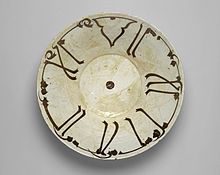

Example showing Nastaliq'due south proportional rules
Persian calligraphy has been present in the Western farsi region before Islamisation. In Zoroastrianism, beautiful and articulate writings were always praised.[ commendation needed ]
It is believed[ by whom? ] that ancient Western farsi script was invented by almost 600–500 BCE to provide monument inscriptions for the Achaemenid kings.[ citation needed ] These scripts consisted of horizontal, vertical, and diagonal nail-shape letters, which is why information technology is chosen cuneiform script (lit. "script of nails") ( khat-e-mikhi ) in Persian. Centuries later, other scripts such as "Pahlavi" and "Avestan" scripts were used in ancient Persia. Pahlavi was a middle Farsi script developed from the Aramaic script and became the official script of the Sassanian empire (224-651 CE).[ citation needed ] The Farsi-Avestan alphabet (alefbâ Pârsi Avestâyi) was created[ when? ] past Lourenço Menezes D'Almeida and is an alternative script for writing the Persian and Avestan languages.[ citation needed ] [ original enquiry? ]
Gimmicky scripts [edit]
The Nasta'liq style is the most popular contemporary style among classical Farsi calligraphy scripts;[ commendation needed ] Persian calligraphers phone call it the "bride of calligraphy scripts". This calligraphy manner has been based on such a strong structure that it has changed very little since Mir Ali Tabrizi had found the optimum limerick of the letters and graphical rules.[ citation needed ] It has just been fine-tuned during the past vii centuries.[ description needed ] It has very strict rules for graphical shape of the messages and for combination of the letters, words, and composition of the whole calligraphy piece.[ citation needed ]
Mod calligraphy [edit]
Revival [edit]
After printing became ubiquitous from the 15th century onward, the production of illuminated manuscripts began to decline. [46] However, the rise of printing did not mean the end of calligraphy.[47] A clear stardom between handwriting and more than elaborate forms of lettering and script began to brand its way into manuscripts and books at the beginning of the 16th century.

The modern revival of calligraphy began at the stop of the 19th century, influenced by the aesthetics and philosophy of William Morris and the Arts and Crafts movement. Edward Johnston is regarded as being the father of modernistic calligraphy.[48] [49] [fifty] After studying published copies of manuscripts past builder William Harrison Cowlishaw, he was introduced to William Lethaby in 1898, principal of the Central School of Arts and Crafts, who advised him to written report manuscripts at the British Museum.[51]
This triggered Johnston'southward involvement in the art of calligraphy with the use of a broad-edged pen. He began a teaching grade in calligraphy at the Primal School in Southampton Row, London from September 1899, where he influenced the typeface designer and sculptor Eric Gill. He was commissioned past Frank Selection to design a new typeface for London Cloak-and-dagger, still used today (with minor modifications).[52]
He has been credited for reviving the art of modern penmanship and lettering single-handedly through his books and teachings – his handbook on the discipline, Writing & Illuminating, & Lettering (1906) was particularly influential on a generation of British typographers and calligraphers, including Graily Hewitt, Stanley Morison, Eric Gill, Alfred Fairbank and Anna Simons. Johnston also devised the simply crafted round calligraphic handwriting style, written with a broad pen, known today as the Foundational hand. Johnston initially taught his students an uncial hand using a flat pen angle, but later taught his hand using a slanted pen bending.[53] He outset referred to this hand equally "Foundational Hand" in his 1909 publication, Manuscript & Inscription Messages for Schools and Classes and for the Utilize of Craftsmen.[54]
Subsequent developments [edit]
Graily Hewitt taught at the Central Schoolhouse of Arts and Crafts and published together with Johnston throughout the early on part of the century. Hewitt was central to the revival of gilding in calligraphy, and his prolific output on type design besides appeared between 1915 and 1943. He is attributed with the revival of gilding with gesso and gold leaf on vellum. Hewitt helped to found the Order of Scribes & Illuminators (SSI) in 1921, probably the world'southward foremost calligraphy social club.

Hewitt is non without both critics[55] and supporters[56] in his rendering of Cennino Cennini's medieval gesso recipes.[57] Donald Jackson, a British calligrapher, has sourced his gesso recipes from earlier centuries a number of which are not presently in English translation.[58] Graily Hewitt created the patent announcing the award to Prince Philip of the title of Knuckles of Edinburgh on November 19, 1947, the day before his marriage to Queen Elizabeth.[59]
Johnston's pupil, Anna Simons, was instrumental in sparking off interest in calligraphy in Frg with her German language translation of Writing and Illuminating, and Lettering in 1910.[48] Austrian Rudolf Larisch, a instructor of lettering at the Vienna Schoolhouse of Fine art, published six lettering books that greatly influenced German-speaking calligraphers. Considering German-speaking countries had not abandoned the Gothic manus in press, Gothic likewise had a powerful upshot on their styles.
Rudolf Koch was a friend and younger gimmicky of Larisch. Koch's books, type designs, and teaching fabricated him one of the nearly influential calligraphers of the 20th century in northern Europe and later on in the U.S. Larisch and Koch taught and inspired many European calligraphers, notably Karlgeorg Hoefer, and Hermann Zapf.[60]
Gimmicky typefaces used by computers, from word processors like Microsoft Discussion or Apple Pages to professional person design software packages like Adobe InDesign, owe a considerable debt to the past and to a small number of professional typeface designers today.[one] [four] [61]
Unicode provides "Script" and "Fraktur" Latin alphabets that tin can be used for calligraphy. See Mathematical Alphanumeric Symbols.
See too [edit]
- Asemic writing – Wordless open up semantic form of writing
- Bastarda – Blackletter script used in France and Frg
- Blackletter – Historic European script and typeface
- Book hand – Legible handwriting style
- Brāhmī script – Ancient script of Cardinal and South Asia
- Calligraffiti – Calligraphy/typography/graffiti art form
- Chancery hand – Any of several styles of celebrated handwriting
- Concrete poetry – Genre of poesy with lines bundled as a shape
- Courtroom mitt – Style of handwriting used in medieval English police force courts
- Cursive – Style of penmanship in which characters are written joined together in a flowing way
- Handwriting – Writing created by a person with a writing implement
- History of writing – Creation and development of permanent, physical records of language
- Italic script – Semi-cursive, slightly sloped style of handwriting and calligraphy developed in Italy
- List of calligraphers
- Mathematical Alphanumeric Symbols
- Micrography – Art genre using minute Hebrew letters
- Palaeography – Study of historic handwriting
- Penmanship – Technique of writing with the hand
- Ronde script (calligraphy)
- Rotunda (script) – Medieval blackletter script
- Round hand – Type of handwriting
- Secretary hand – Style of European handwriting
- Siyah mashq – Calligraphic practice sheets
- Sofer – Jewish scribe
Notes [edit]
- ^ a b c d Mediaville, Claude (1996). Calligraphy: From Calligraphy to Abstruse Painting. Belgium: Scirpus-Publications. ISBN978-90-803325-i-5.
- ^ Pott, G. (2006). Kalligrafie: Intensiv Training [Calligraphy: Intensive Training] (in German). Verlag Hermann Schmidt. ISBN978-three-87439-700-1.
- ^ Pott, Chiliad. (2005). Kalligrafie: Erste Hilfe und Schrift-Grooming mit Muster-Alphabeten (in German). Verlag Hermann Schmidt. ISBN978-3-87439-675-2.
- ^ a b Zapf, H. (2007). Alphabet Stories: A Chronicle of technical developments. Rochester, NY: Cary Graphic Arts Press. ISBN978-1-933360-22-5.
- ^ Zapf, H. (2006). The globe of Alphabets: A kaleidoscope of drawings and letterforms. CD-ROM
- ^ Propfe, J. (2005). SchreibKunstRaume: Kalligraphie im Raum Verlag (in High german). Munich: Callwey Verlag. ISBN978-iii-7667-1630-9.
- ^ Geddes, A.; Dion, C. (2004). Miracle: a celebration of new life. Auckland: Photogenique Publishers. ISBN978-0-7407-4696-3.
- ^ Reaves, Chiliad.; Schulte, E. (2006). Brush Lettering: An instructional manual in Western brush calligraphy (Revised ed.). New York: Design Books.
- ^ Child, H., ed. (1985). The Calligrapher's Handbook. Taplinger Publishing Co.
- ^ Lamb, C.Thousand., ed. (1976) [1956]. Calligrapher's Handbook. Pentalic.
- ^ "Newspaper Properties in Standard arabic calligraphy". calligraphyfonts.info. Archived from the original on 2017-03-xiii. Retrieved 2007-06-01 .
- ^ "Calligraphy Islamic website". Calligraphyislamic.com. Archived from the original on 2012-06-08. Retrieved 2012-06-18 .
- ^ 書 (Taiwanese) being here used equally in 楷书 (Cantonese) or 楷書 (Taiwanese), meaning "writing style",[ description needed ]
- ^ Sato, Shozo (2014-03-11). Shodo: The Placidity Art of Japanese Zen Calligraphy, Larn the Wisdom of Zen Through Traditional Brush Painting. Tuttle Publishing. ISBN978-1-4629-1188-2.
- ^ Nornes, Abé Markus (2021-02-22). Brushed in Calorie-free: Calligraphy in East Asian Cinema. Academy of Michigan Press. ISBN978-0-472-13255-3.
- ^ Categories of Calligraphy – Seal Script. (n.d.). Retrieved May 30, 2018, from http://www.cityu.edu.hk/lib/about/event/ch_calligraphy/seal_eng.htm
- ^ The Bell and Cauldron Inscriptions-A Feast of Chinese Characters: The Origin and Development_Mao Gong Ding. (northward.d.). Retrieved May 30, 2018, from https://www.npm.gov.tw/exh99/bell/3_en.htm
- ^ Fazzioli, Edoardo (1987). Chinese Calligraphy: From Pictograph to Ideogram: The History Of 214 Essential Chinese/Japanese Characters. Calligraphy by Rebecca Hon Ko. New York: Abbeville Press. p. thirteen. ISBN978-0-89659-774-7.
And then the first Chinese dictionary was born, the Sān Chāng, containing 3,300 characters
- ^ a b c d e R. B. Blakney (2007). A Grade in the Analysis of Chinese Characters. Lulu.com. p. 6. ISBN978-one-897367-xi-seven. [ self-published source ]
- ^ Z. (n.d.). Chinese Calligraphy. Retrieved May 30, 2018, from http://www.ebeijing.gov.cn/Culture/Culture_Recommendation/t1068241_2.htm
- ^ 康熙字典 [Kangxi Zidian] (in Chinese). 1716. p. 41. . See, for example, the radicals 卩 , 厂 , or 广 . The 2007 common shape for those characters does not clearly show the stroke order, but old versions, visible on p. 41, conspicuously permit the stroke order to be determined.
- ^ Li, J. (Ed.). (n.d.). "4 treasures of Report" tour. Retrieved May 30, 2018, from http://www.chinadaily.com.cn/k/anhui/travel/2010-06/02/content_9948922.htm
- ^ Suzuki, Yuuko (2005). An introduction to Japanese calligraphy. Tunbridge Wells: Search. ISBN978-i-84448-057-nine.
- ^ "Philippine Paleographs (Hanunoo, Buid, Tagbanua and Pala'wan) – United Nations Educational, Scientific and Cultural System". www.unesco.org.
- ^ "'Educate first': Filipinos react to Baybayin as national writing system". 27 April 2018.
- ^ "House panel approves Baybayin equally national writing system". 24 April 2018.
- ^ "five things to know about PH's pre-Hispanic writing system". ABS-CBN News. 25 April 2018.
- ^ Stanley Baldwin O. See (15 August 2016). "A primer on Baybayin". gmanetwork.com.
- ^ Michael Wilson I. Rosero (26 April 2018). "The Baybayin neb and the never ending search for 'Filipino-ness'". CNN Philippines. Archived from the original on 5 May 2020.
- ^ "10 Perfectly Awesome Calligraphers You Need To Check Out". brideandbreakfast.ph. 12 August 2015.
- ^ Deni Rose M. Afinidad-Bernardo (ane June 2018). "How to ace in script lettering". philstar.com.
- ^ Salomon, Richard (1998). Indian Epigraphy: A Guide to the Study of Inscriptions in Sanskrit, Prakrit, and the Other Indo-Aryan Languages. Oxford, New York: Oxford University Press. ISBN978-0195099843.
- ^ Mitter, Partha (2001). Indian Fine art. Oxford, New York: Oxford Academy Press. p. 100. ISBN9780192842213.
- ^ Sabard, Five.; Geneslay, V.; Rébéna, L. (2004). Calligraphie latine: Initiation [Latin calligraphy: Introduction] (in French) (7th ed.). Paris. pp. viii–11. ISBN978-ii-215-02130-8.
- ^ Insular Manuscripts: Paleography Section six: Language on the Page in Insular Manuscripts Layout and Legibility. (due north.d.). Retrieved May 30, 2018, from https://www.vhmml.org/school/lesson/insular-paleography/layout
- ^ de Hamel, C. (2001a) The Book: A History of the Bible. Phaidon Printing
- ^ Knight 1998: x
- ^ Trinity Higher Library Dublin 2006; Walther & Wolf 2005; Brown & Lovett 1999: twoscore; Backhouse 1981
- ^ Jackson 1981: 64
- ^ Walther & Wolf 2005; de Hamel 1994: 46–48
- ^ de Hamel 1994: 46
- ^ a b Lovett, Patricia (2000). Calligraphy and Illumination: A History and Practical Guide. Harry North. Abrams. ISBN978-0-8109-4119-nine.
- ^ a b c d Joyce Irene Whalley (c. 1980). The Art of Calligraphy, Western Europe & America.
- ^ Brown, M.P. (2004). Painted Labyrinth: The Earth of the Lindisfarne Gospel (Revised ed.). British Library.
- ^ The Bible: New Living Translation. Tyndale Business firm Publishers. 2000.
- ^ de Hamel 2001a; de Hamel 1986
- ^ Zapf 2007; de Hamel 2001a; Gilderdale 1999; Gray 1971
- ^ a b "The Legacy of Edward Johnston". The Edward Johnston Foundation.
- ^ Cockerell 1945; Morris 1882
- ^ "Font Designer — Edward Johnston". Linotype GmbH. Retrieved 5 November 2007.
- ^ such as the Ramsey Psalter, BL, Harley MS 2904
- ^ The Eric Gill Society: Assembly of the Guild: Edward Johnston
- ^ Gilderdale 1999
- ^ Baines & Dixon 2003: 81
- ^ Tresser 2006
- ^ Whitley 2000: ninety
- ^ Herringham 1899
- ^ Jackson 1981: 81
- ^ Hewitt 1944-1953
- ^ Cinamon 2001; Kapr 1991
- ^ Henning, W.East. (2002). Melzer, P. (ed.). An Elegant Hand: The Gilt Age of American Penmanship and Calligraphy. New Castle, Delaware: Oak Knoll Press. ISBN978-1-58456-067-8.
References [edit]
- Oscar Ogg (1954), Three classics of Italian Calligraphy, an entire reissue of the writing books of Arrighi, Giovanni Antonio Tagliente & Palatino, with an introduction, Dover publications inc. New York, USA
- John Howard Benson & Arthur Graham Carrey (1940), The Elements of Lettering, John Stevens, Newport, Rhode Island, printed by: D. B. Updike at The Merrymount Press, Boston
- John Howard Benson (1955), The offset writing book, an English translation & fascimile text of Arrighi'southward Operina, the showtime Manual of the chancery hand, London Oxford University press, Geoffrey Cumberlege New Haven Yale University Press.
- Berthold Wolpe (1959), A newe writing booke of copies, 1574, A fascimile of a unique Elisabethan Writing book in the Bodleian Library Oxford, Lion and Unicorn Press, London
- Diringer, D. (1968). The Alphabet: A Fundamental to the History of Mankind. Vol. 1 (3rd ed.). London: Hutchinson & Co. p. 441.
- Fairbank, Alfred, (1975). Augustino Da Siena, the 1568 edition of his writing book in fascimile, David R. Godine (Boston) & The Merrion Press, (London), ISBN 0-87923-128-9
- A. South. Osley (editor), Calligraphy and Paleography, Essays presented to Alfred Fairbank on his 70th birthday, October House Inc. New York, 1965.
- Fraser, K.; Kwiatowski, W. (2006). Ink and Gold: Islamic Calligraphy. London: Sam Fogg Ltd.
- Gaze, T. & Jacobson, K. (editors), (2013). An Anthology Of Asemic Handwriting. Uitgeverij. ISBN 978-90-817091-seven-0
- Johnston, E. (1909). "Plate 6". Manuscript & Inscription Letters: For schools and classes and for the apply of craftsmen. San Vito Press & Double Elephant Printing. 10th Impression
- Marns, F.A (2002) Various, copperplate and grade, London
- Mediavilla, Claude (2006). Histoire de la calligraphie française (in French). Paris: Michel. ISBN978-2-226-17283-nine.
- Shepherd, Margaret (2013). Acquire Earth Calligraphy: Discover African, Arabic, Chinese, Ethiopic, Greek, Hebrew, Indian, Japanese, Korean, Mongolian, Russian, Thai, Tibetan Calligraphy, and Beyond. Crown Publishing Group. p. 192. ISBN978-0-8230-8230-8.
- Annemarie Schimmel, Calligraphy and Islamic Civilization. New York University Press. 1984. ISBN978-0-8147-7830-2.
- Wolfgang Kosack: Islamische Schriftkunst des Kufischen Geometrisches Kufi in 593 Schriftbeispielen. Deutsch – Kufi – Arabisch. 380 Seiten. Verlag Christoph Brunner, Basel 2014, ISBN 978-three-906206-10-3.
External links [edit]
- Calligraphy alphabets, a listing of major historical scripts (simplified version) at Lettering Daily
- Calligraphy at Curlie
- French Renaissance Paleography This is a scholarly maintained site that presents over 100 carefully selected French manuscripts from 1300 to 1700, with tools to decipher and transcribe them.
Source: https://en.wikipedia.org/wiki/Calligraphy

Post a Comment for "Nib and Ink the Art of Creative Handwriting and Modern Calligraphy"